

The Capital-Raising Path Many Real Estate Entrepreneurs Overlook And Why It’s Not Just for Tech Startups

Regulation Crowdfunding (Reg CF) is a U.S. law that lets small businesses and real estate entrepreneurs raise up to $5 million in 12 months from both accredited and non-accredited investors, using a regulated online portal.
If you’re an entrepreneur, you’ve probably heard “crowdfunding” and thought of gadgets on Kickstarter or early-stage tech startups. But Reg CF opens a very different door: it lets you legally market a real estate investment and lets everyday investors participate with smaller checks.
For most real estate entrepreneurs, the funding options have felt binary for years:
- Banks that move slowly, demand piles of documentation, and may still say no.
- Hard money that’s fast, but expensive enough to eat into your margins.
Regulation Crowdfunding is often described as a third lane: it doesn’t replace your bank or private lenders overnight, but it gives you a way to invite your broader community to back your deals in smaller amounts—legally and at scale
What Is Regulation Crowdfunding in Simple Terms?
Regulation Crowdfunding is a way for small businesses and real estate entrepreneurs to raise investment capital online, from the general public, under a specific set of SEC rules.
Here’s what makes it different from the “Kickstarter” you’re used to:
Not donations or pre-orders
Backers are not buying a T-shirt or early access. They are investing money in your project or company.
Investors get a financial stake
They may receive equity, a revenue share, or some other structured return that you define in your offering.
Runs through a regulated portal
Your raise must be hosted on a FINRA-regulated crowdfunding portal or broker-dealer platform that is approved to handle Reg CF offerings.
In short: Reg CF turns your deal into a regulated online investment offering, not just a marketing page.
How Did the JOBS Act Change Capital Raising for Small Real Estate Entrepreneurs?
The JOBS Act made it possible for regular people to invest small amounts in private deals and allowed small businesses to market their offerings more openly.
Before the JOBS Act:
- You were usually limited to accredited investors (high income or high net worth).
- Publicly advertising a raise was heavily restricted.
- The legal/compliance overhead made raising small amounts very difficult.
The JOBS Act, and specifically Reg CF, changed this:
- Non-accredited investors can invest small amounts based on their income and net worth.
- You can publicly talk about your raise (within certain limits) and send people to your Reg CF portal page.
- Investor protections (investment caps, disclosure rules, use of regulated portals) make it safer for both issuers and investors.
For a real estate entrepreneur, that means you’re no longer limited to a handful of wealthy contacts or expensive hard money. You can open your deals to a wider community, legally and at scale.
What Can You Actually Do With Regulation Crowdfunding (Reg CF)?
With Reg CF, you can raise up to $5 million in 12 months, accept smaller checks from everyday investors, and market your offering through a regulated portal.
Let’s break that into smaller questions.
How Much Can I Raise With Reg CF?
- You can raise up to $5 million within a 12-month period under Regulation Crowdfunding.
- That can be one large raise or multiple offerings, as long as the total stays under the cap.
Who Can Invest in My Reg CF Real Estate Deal?
- Accredited and non-accredited investors can both participate.
- Non-accredited investors are limited by how much they can invest across all Reg CF offerings each year, based on income and net worth.
- The portal handles those calculations and checks, so you don’t have to manage it manually.
Can I Advertise My Reg CF Raise?
Yes, with rules:
- You can publicly promote your offering on social media, email, your website, podcasts, and in person.
- Most of that promotion must point people back to your official offering page on the Reg CF portal.
- You’ll be limited in how much detail you can share outside the portal, but you can let the world know you’re raising and where to go.
In practice, Reg CF allows issuers to inform their broader network that an offering exists, provided that most substantive information is housed on the official portal page and marketing communications remain within SEC guidelines.
Why Is Regulation Crowdfunding a Good Fit for Real Estate Deals?
Reg CF works especially well for real estate because the assets are tangible, the story is local, and the return profiles are easier to explain than early-stage tech.
Why Do Everyday Investors Like Real Estate in Reg CF?
- It’s tangible: People can see the property, drive by it, and understand what’s being built or improved.
- It’s familiar: Even if investors don’t know cap rates, they grasp “buy, fix, rent, and refinance” or “build and sell.”
- It feels less abstract: Compared to a pre-revenue app, a duplex or townhome project feels more grounded.
How Does Real Estate Benefit From a “Crowd” of Investors?
- Local pride: Neighbors, small business owners, and community members often want to invest in their own city.
- Smaller checks, bigger total: Instead of chasing one $500K check, you might collect 100 checks of $5K each.
- Repeat investors: If your first deal performs, those investors are more likely to follow you into future offerings.
For an entrepreneur, this means Reg CF can help you build a long-term investor community around your brand and your market.
What Responsibilities Come With Regulation Crowdfunding?
Reg CF is powerful, but it comes with real responsibilities around compliance, deal quality, and how you treat your investors. It’s not “free money”—it’s a regulated path to raising capital.
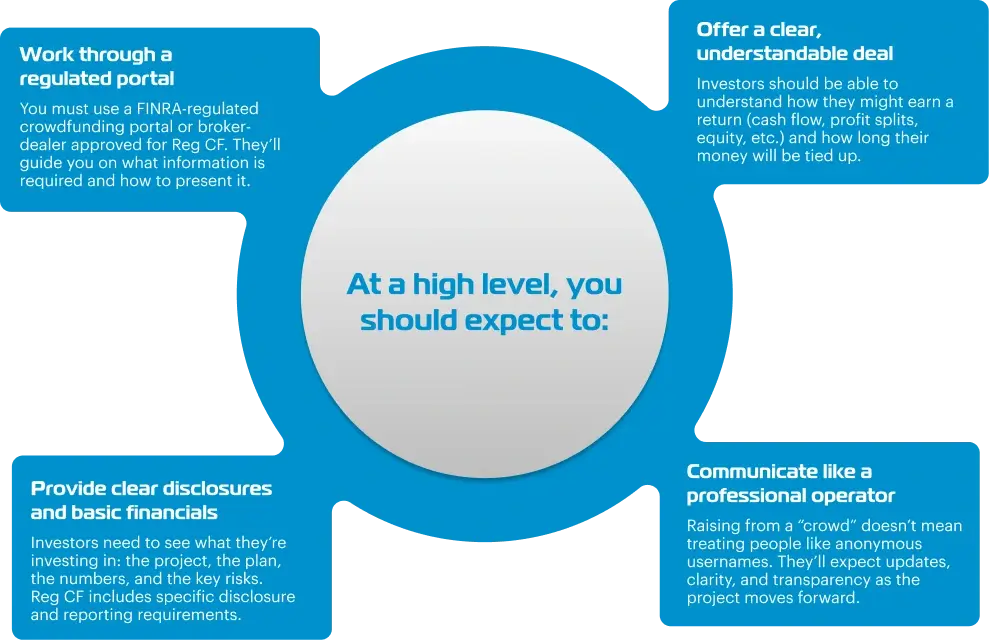
Most real estate entrepreneurs lean on a securities attorney and the portal’s guidance for their first Reg CF raise. You don’t have to know every rule by heart—you just need to be willing to follow a real process.
When Does It Make Sense to Explore Reg CF Further?
You don’t have to decide today if Reg CF is your main capital strategy. At this stage, your only job is to understand that this path exists and see whether it’s worth exploring more deeply.
It’s worth taking a closer look at Reg CF if:
- Your deals typically need between $100K and $5M in equity.
- Banks and hard money lenders are limiting your growth or eating your margins.
- You like the idea of including smaller investors instead of relying only on a few big partners.
- You see value in building a long-term investor community around your brand and your market.
If that sounds like where you are—or where you want to be—Reg CF can become a powerful addition to your capital stack alongside traditional debt, private equity, and joint ventures.
Where to Go Next: Planning Your First Reg CF Raise
Regulation Crowdfunding gives real estate entrepreneurs a way to fund deals by turning their community into investors—legally, transparently, and at scale. But understanding that Reg CF exists is just the first step.
The next level is seeing how three big shifts come together in your favor:
- The JOBS Act, which gives you the legal framework to raise from the crowd
- The Connection Economy, which rewards the entrepreneurs who build real trust and community.
- Modern SaaS platforms, which handle the logistics, compliance, and investor onboarding so you can scale without losing your mind.
If that sounds like where you are—or where you want to be—Reg CF can become a powerful addition to your capital stack alongside traditional debt, private equity, and joint ventures.
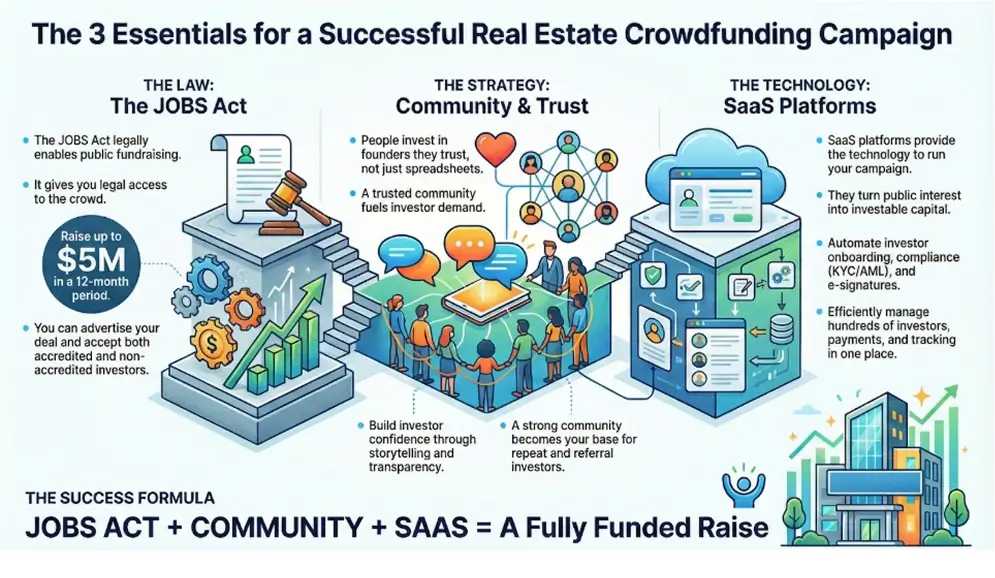
Together, they form a new capital playbook for raising anywhere from $50K to $5M without being entirely dependent on banks, hard money, or a few gatekeepers.
If you’re interested in seeing how real-world crowdfunding investments actually play out over time, the next article breaks down a $10,000 real estate deal and what issuers can learn from its structure, projections, and outcome.
Read next: “Crowdfunding Lessons Learned From a $10,000 Real Estate Investment” — a practical look at how expectations, alignment, and communication shape results in crowdfunded real estate deals.