

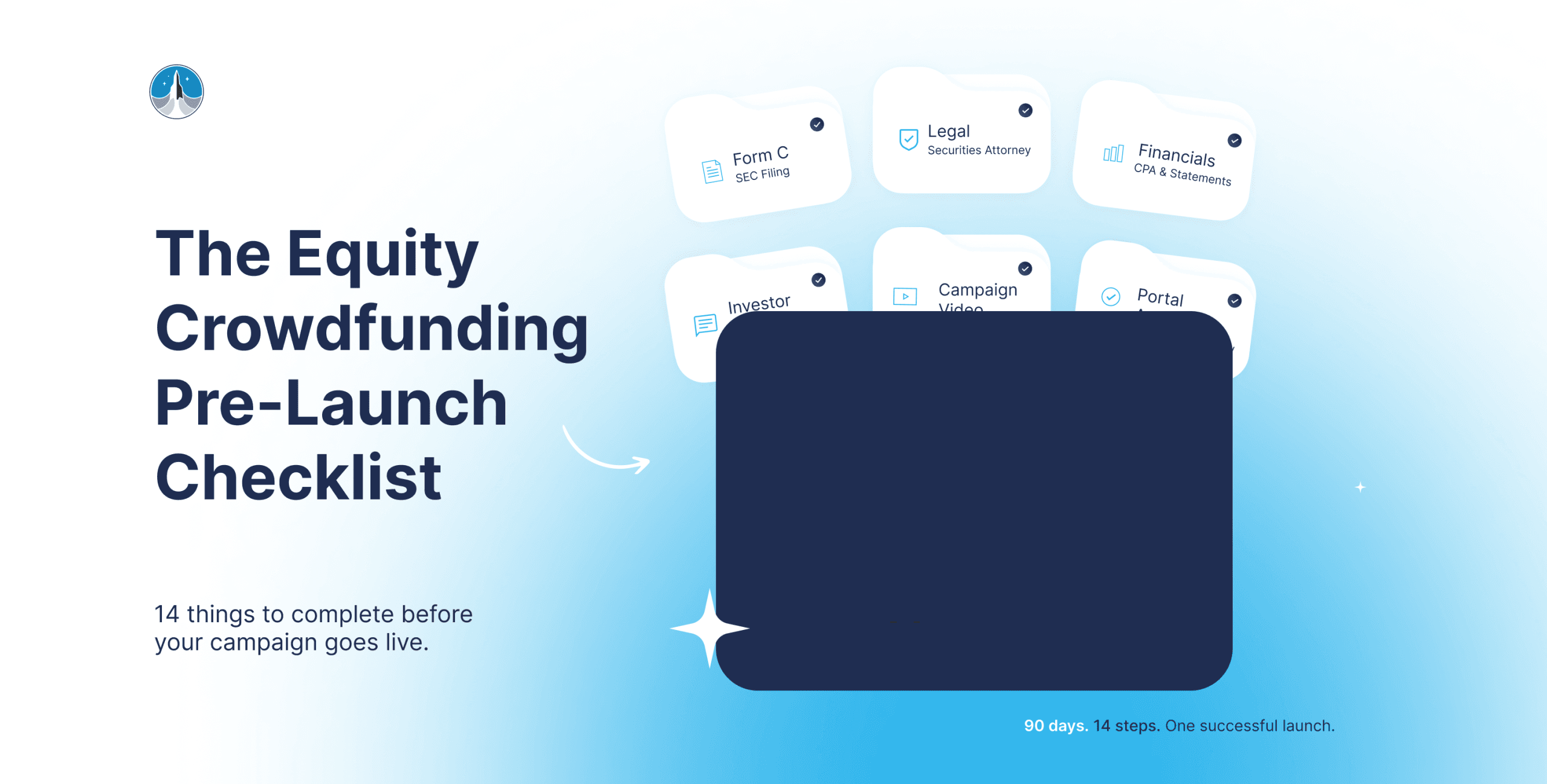
The Equity Crowdfunding Pre-Launch Checklist: 14 Things to Complete Before Your Campaign Goes Live
The founders who raise successfully on equity crowdfunding platforms share one thing in common: they treat the raise as an operational project, not a product launch. They do the legal groundwork before they do any marketing. They build the investor list before the campaign opens. They arrive on Day One with momentum already behind them.
What follows is not a reference document. It is a project plan, built around a 90-day pre-launch window and organized by when each item must be completed.
The sequence matters more than most founders expect. Several steps have regulatory dependencies that determine what you can and cannot do at each stage. Skipping ahead does not accelerate the timeline. It creates compliance exposure.
Work through this in order.

Phase 1: Month One (Days 90 to 60)
Legal, Financial, and Platform Foundations
The first month is not about marketing. It is about building the foundation your campaign is legally required to have before any public promotion can begin. Everything in Phase 2 depends on this.
1. Decide which exemption you are raising under
Before you engage an attorney, a platform, or a CPA, make one decision: which securities exemption governs your raise.
Regulation Crowdfunding allows companies to raise up to $5 million in any rolling 12-month period from both accredited and non-accredited investors, conducted entirely through a registered funding portal or broker-dealer.
Regulation A+ raises that ceiling to $75 million annually and permits broader advertising. Regulation D, Rule 506(c), carries no raise cap but limits participation to accredited investors only.
Each exemption carries different financial disclosure requirements, investor eligibility rules, platform/portal options, and ongoing reporting obligations. The exemption you choose governs everything downstream, including which steps in this checklist apply to you and in what form.
For most early-stage companies raising under $5 million for the first time, Reg CF is the logical starting point. That is the framework this checklist is built around. If your target raise or investor base requirements point toward Reg A+ or Reg D, the sequencing logic holds, but the specific regulatory requirements in steps two through four will differ.
Settle this before you spend a dollar on legal fees.
Related reading: The Pros and Cons of Regulation Crowdfunding
2. Choose your funding portal
Reg CF offerings must be conducted through an SEC-registered, FINRA-member funding portal or broker-dealer. You cannot run the campaign on your own website, through a general payment processor, or on a platform that is not registered as an intermediary.
The portal’s compliance team reviews your campaign page, marketing materials, and pre-launch communications before anything goes live. Planet Wealth is a FINRA-registered funding portal. If you need guidance on selecting a portal, or help connecting with a Reg CF-experienced securities attorney or CPA, our team can make that introduction. That support is part of what we offer founders who work with us.
3. Engage a securities attorney
Form C is the SEC disclosure document that must be filed before your campaign goes live. It must also be filed before you take any steps to publicly promote the offering. That sequencing is not discretionary. The SEC requires it. Your funding portal will not publish your live campaign without a filed Form C. You can, however, float a “test the waters” campaign that lets you gather interest from potential investors.
Form C is a detailed document. It requires a full narrative description of your business and business plan, financial statements prepared to the standard appropriate for your raise size, a breakdown of how you intend to use the proceeds, a description of the securities being offered, the offering terms, and a candid account of the material risks associated with investing in your company.
Every statement in the filing must be accurate, complete, and consistent with everything else in your offering materials. Errors and omissions create regulatory exposure that extends well beyond the campaign itself.
The SEC’s compliance guide for Reg CF issuers is a useful primary reference for what Form C requires at each stage.
4. Determine your financial statement tier and engage a CPA (if needed)
The level of financial scrutiny your campaign requires depends on how much plan to raise (across all Reg CF activity in the prior 12 months, not just the current campaign).
If you’re raising under $124,000 via Reg CF in a rolling 12-month period, your financial statements need only be certified as accurate by your principal executive officer. No external accountant is required. If that aggregate falls between $124,000 and $1,235,000, an independent CPA must review the statements. Above $1,235,000, a full audit is required.
The cumulative calculation is the part most founders miss. If you raised $400,000 under Reg CF eight months ago and are now raising $600,000, your aggregate is $1,000,000, and a CPA review applies. The 12-month window rolls continuously, not by calendar year.
To work around this, some founders file their Form C with the intention to raise a modest initial amount, then file an amendment once that target is reached. If the initial raise falls below the audit threshold, no external accountant is required at the outset.
Once the raise closes and proceeds are in hand, a portion of those funds can be used to cover the audit costs required for any subsequent raise above the threshold. This is a compliant approach, and it is worth discussing with your attorney at the outset.
Of all the pre-launch workstreams, financial preparation is reliably the most time-consuming. Engage your CPA at the same time you engage your attorney. Both workstreams feed directly into the Form C being drafted, and neither can wait on the other.
One way to manage the cost: some founders file their Form C with the intention to raise a modest initial amount, then file an amendment once that target is reached. If the initial raise falls below the audit threshold, no external accountant is required at the outset.
Once the raise closes and proceeds are in hand, a portion of those funds can be used to cover the audit costs required for any subsequent raise above the threshold. This is a compliant approach, and it is worth discussing with your attorney at the outset.
5. Set your raise target and offering terms
Two of the most important numbers that define the structure of your campaign are: a) A minimum target and b) A maximum target.
The minimum is the floor. If your campaign closes without reaching it, all investment commitments are canceled and returned to investors. Set it at the amount you actually need to reach your next meaningful milestone, whether that is completing a development stage, reaching a specific revenue marker, or funding a defined expansion.
A floor that sounds ambitious but is not tied to a concrete plan is harder to defend to investors than one that is specific and honest.
The maximum is the ceiling on how much you will accept. You can allow over-subscriptions up to the Reg CF limit, but you must decide in advance how over-subscriptions will be allocated: pro-rata, first-come-first-served, or at your discretion. That decision is documented in your Form C.
On the instrument side, most Reg CF campaigns use SAFEs, Simple Agreements for Future Equity. A SAFE is not equity. It is a contract that gives the investor the right to receive equity at a future date, typically when you raise a priced round, get acquired, or hit a milestone you define in advance.
Two terms govern how that conversion works: a valuation cap, which sets the maximum company valuation at which the investor’s SAFE converts (protecting them from being diluted if the company’s value has grown significantly by the time of conversion), and a discount rate, which gives them shares at a lower price per share than what new investors pay in that future round.
Other commonly used instruments include priced equity with a defined share price and revenue-sharing notes.
Each instrument carries different implications for dilution,investor rights, and downstream fundraising. Your attorney will walk through the tradeoffs. Your job is to understand the terms well enough to be able to explain them clearly to your investors.
Phase 2: Month Two (Days 60 to 30)
Narrative, Infrastructure, and Early Momentum
Legal and financial work is underway. Month Two shifts to the investor-facing materials and the first form of outreach available before Form C is filed.
6. Build your investor narrative
A pitch deck is a format. An investor narrative is the story you’re actually telling. The distinction matters because every investor-facing asset you produce–your campaign page, your campaign video, your email outreach, your social content–should cohesively align with that story.
That argument must answer five questions without hedging:
- What problem are you solving, and who is paying to have it solved?
- What is your business model
- What does your traction look like?
- Why is this team the one to execute?
- What will you do with the capital?
Write this out as a document first, in plain prose. Not slides. The discipline of writing it in full sentences forces you to find the gaps in your reasoning before an investor does. Once the narrative holds together on the page, the deck, the campaign page, and the video script follow from it directly.
Related reading: Telling the Right Story: Clear Messaging and Investor Attraction
7. Run a Testing the Waters campaign
Under Reg CF Rule 206, you can solicit indications of interest from potential investors before Form C is filed, provided your materials include required disclaimers and you file those materials with the SEC. This is called Testing the Waters, and it is the most underused tool available to founders at this stage.
A TTW campaign lets you gauge investor appetite before committing to a full launch, identify which messaging angles generate the strongest response, build a list of warm leads who have already raised their hand, and arrive at your live campaign with evidence of demand already in hand.
The compliance requirements are not complex, but they are not optional. All TTW materials, including emails, social posts, and any landing pages used to collect interest, must carry a disclaimer stating that no money is being accepted and that the offering has not been qualified by the SEC. All materials must later be filed with the SEC and preserved for your portal’s review if and when you proceed to a live offering.
Have your portal’s compliance contact review your TTW materials before distribution. The SEC’s guidance for Reg CF issuers covers the Testing the Waters rules in full detail. A well-run TTW campaign compresses the gap between your launch date and meaningful first-week funding in a way that nothing else at this stage can.
8. Build your pre-launch landing page and email list
Before your campaign is live on the portal, you need a standalone landing page that captures interest. If you ran a TTW campaign in Step 7, this page may already exist. If so, confirm it meets the TTW compliance requirements covered in that step and continue building the list from it.
The people who sign up here are your most likely “Day-One investors.” They have already demonstrated enough intent to hand you their contact information. Send a welcome email the same day they subscribe. Update them every two weeks as you approach launch. Give them information your general audience does not have access to.
Your pre-launch email list is the mechanism by which you manufacture Day One momentum. That momentum is the single most important factor in whether your campaign gains traction or stalls on launch. Everything else is secondary to this.
Related reading: Behind the Funnel: What Successful Reg CF Campaigns Get Right
9. Produce your campaign video
Most portals require a campaign video, and investors expect one. Its job is to make a founder credible and a business tangible in two to four minutes. Production quality helps at the margin. It is not the primary variable.
Founders who speak directly to the camera with clarity and genuine conviction, consistently outperform narrated slide presentations with higher production budgets.
You may prepare a script, but avoid memorizing it word for word. Know your pitch well enough to deliver it naturally. Make sure to cover:
- What the business does
- The problem it solves
- The team behind it
- What you are raising and why
- What you will do with the capital
Keep it under 3-4 minutes, and shoot in a clean, well-lit environment.
If budget allows for a professional shoot, use it. If it does not, a well-lit phone video is a more credible signal than a poorly produced studio effort.
Produce this during Month Two so it clears portal review and is ready to publish the day your campaign opens.
10. Segment and activate your warm network
Your first investors will not come from the portal’s general audience. They will come from people who already know you: customers, prior investors, former colleagues, advisors, industry contacts, and personal connections.
Map your contacts now. Go through them deliberately and divide them into three groups:
- People who have the means to invest and a direct relationship with you.
- People who will not invest personally but can make introductions to people who will.
- People who will amplify the campaign publicly once it is live.
The goal is firm commitments from the first group on or near Day One. That requires conversations that start in Month Two.

A campaign that raises 30% of its target in the first 48 hours sends a clear signal to every subsequent investor who visits the page. A campaign sitting at 5% for two weeks sends a different one, and that signal is very difficult to undo regardless of how strong the underlying business is.
Related reading: Deal-Magnet Mindset: Turning Coffee Chats into Prospective Leads
Phase 3: The Final Two Weeks
Campaign-Ready Execution
Form C is filed or in final review. Portal approval is in place. Your warm list is ready. These two weeks are operational. Every asset confirmed, every communication pre-built, every dependency resolved before the campaign opens.
11. Complete your campaign page on the portal
Your campaign page has two jobs: it must satisfy the SEC’s disclosure requirements for Reg CF offerings, and it must function as a persuasive document that gives a skeptical, analytically capable investor a clear basis for making a decision.
On the compliance side, the page must include the same material information as your Form C: offering terms, use of proceeds, company description, team, financial condition, and risk factors. The page cannot contradict or omit anything material from the filing. Any information that appears on the page and relates to the offering falls under securities law.
Within those requirements, the page should do the work of your investor narrative. It should make your argument, show your traction, and explain what you are building in terms a serious investor can evaluate. Use your portal’s page structure as the framework. Use the narrative document from Item 6 as the content source. The two should reinforce each other.
Related reading: Managing Investor Communications: Transparency Best Practices Before, During, and After Your Raise
12. Build and schedule your launch communications
Nothing in your Day One sequence should be written on Day One. By the time the campaign opens, every message should already be written, reviewed, and staged.
The sequence works like this. Two to three days before launch, send a pre-launch email to your full warm list: the exact date and time the campaign opens,a brief campaign overview, and what they need to do.
On launch day, send the announcement email to the full list, post across your social channels, publish a press release to the outlets you have cultivated, and send direct personal messages to the highest-priority contacts from your network map.
In the 48 hours after launch, follow up individually with anyone who indicated interest but has not yet committed. For more detail on what compliant launch communications look like at each stage, the linked guide is worth reading before you draft anything.
All of this should be written in advance. Your portal’s compliance team needs to review your launch communications before they go out. Stage everything in your email platform and social scheduler in advance. Launch day is not a writing day.
13. Confirm portal compliance sign-off
Your campaign cannot open without sign-off from both the SEC and your chosen portal’s compliance officer. This is a formal gate. The compliance team will review your campaign page, Form C, campaign video, pre-launch landing page, any TTW materials distributed, and your proposed launch communications. Any element that does not clear review must be revised before approval is granted.
Most launch delays trace back to compliance review backlogs, not to founder unpreparedness. The portal’s team is reviewing multiple campaigns simultaneously. Submit all materials with enough lead time to absorb at least one round of revisions without pushing your launch date. Do not create new marketing materials during the review window without notifying your compliance contact first.
When sign-off is confirmed, your launch date is set.
14. Test your campaign mechanics and build your in-campaign management schedule
In the 48 to 72 hours before launch, verify every element of the campaign infrastructure. Walk through the investor flow from the campaign page to investment confirmation. Confirm your escrow arrangement is in place.
Check that your analytics tracking is live across all channels. Test your email automation sequences end to end. Review your campaign page on both desktop and mobile.
Then build your management schedule for the full campaign window.
Most Reg CF campaigns run 30 to 90 days. That window requires active work: Q&A responses on the portal, milestone update emails to your list as funding progresses, consistent social content that keeps the campaign visible, and continued outreach to press, community channels, and warm leads who have not yet committed.
Campaigns that reach 60% of their goal and go quiet rarely close. Every investor who visits your page in week four is reading your update cadence as a signal of how you intend to run the company after they invest.
Related reading: What to Do If Your Crowdfunding Campaign Falls Short
One thing worth saying plainly before you start
Most first-time Reg CF founders assume the platform will deliver investors. Some of them will, eventually. But major portals typically surface campaigns to their broader investor audiences only after a campaign has already demonstrated traction, usually upwards of $100,000 raised. The average Reg CF campaign in 2025 closed below that threshold. Most founders never reach the point where platform amplification becomes a meaningful factor.
What that means practically: the 90 days of preparation in this checklist are not supplemental to a platform relationship. They are what makes the platform relationship worth having. The platform provides the infrastructure, the compliance framework, and the credibility to raise from your crowd legally and at scale. You have to bring the crowd.
If you are ready to start, Planet Wealth works with founders across Reg CF, Reg A+, and Reg D to build the compliance and marketing infrastructure this checklist describes. Start your application or schedule a call with our team.