

What Makes Investors Click ‘Invest’ on an Equity Crowdfunding Page: The 6 Elements That Convert
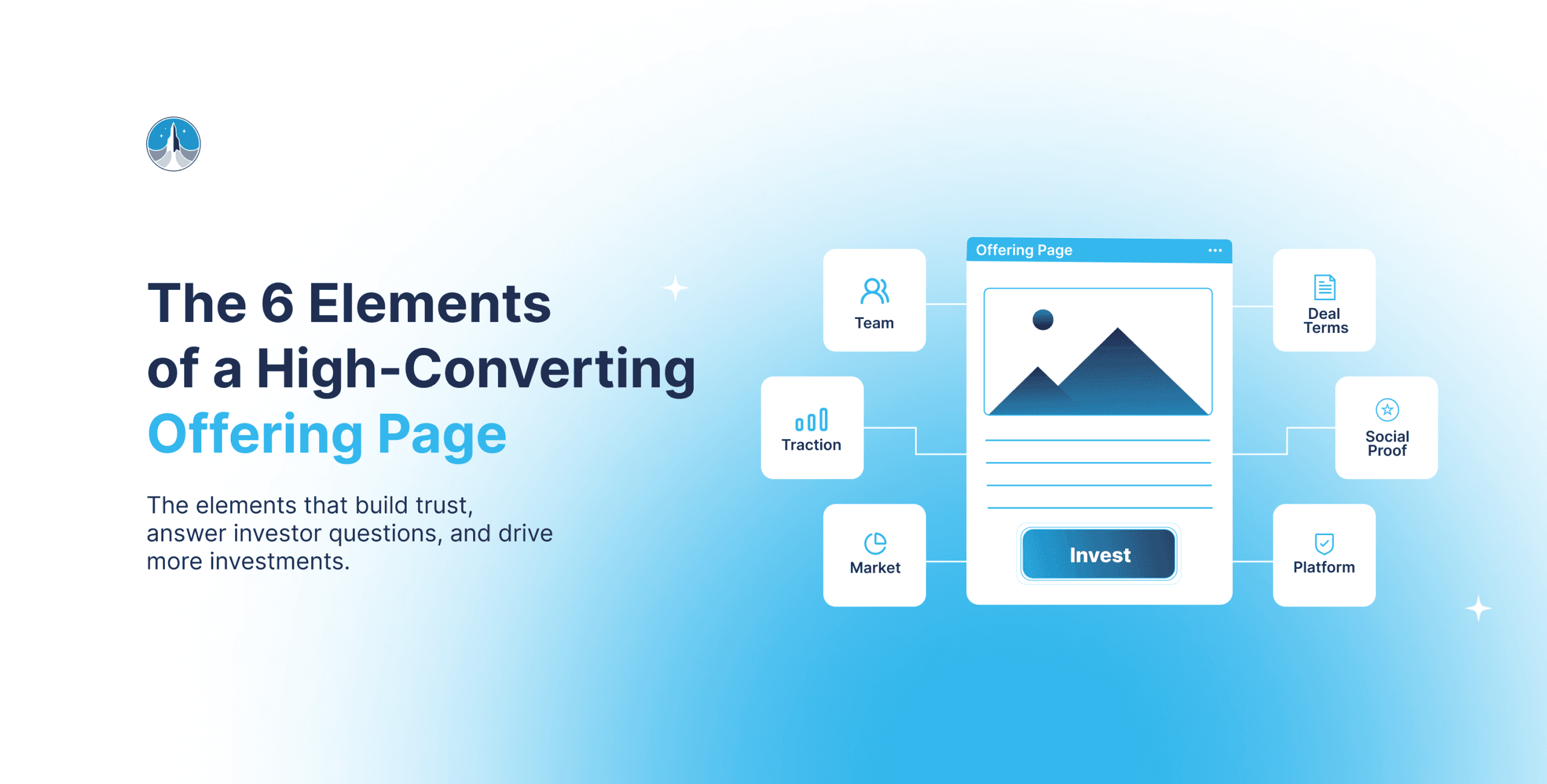
Your offering page is the most consequential piece of real estate in your entire equity crowdfunding raise.
Every ad you run, every email you send, every press mention you earn points investors toward one destination: that page. They arrive with a question: “Is this worth my money?” And they form an answer faster than most founders expect.
How that answer forms is the part most founders get wrong. The offering page is not a pitch deck posted online. It is a decision environment. Investors land on it, scan it, and measure it against a set of trust criteria they often cannot fully articulate. The campaigns that get funded are not always the best businesses. They are the ones whose pages made it easiest for investors to say yes.
This guide covers the 6 elements that determine whether an investor reaches for the invest button or closes the tab, drawn from behavioral research on how retail investors actually evaluate equity crowdfunding campaigns.
How Do Retail Investors Actually Evaluate an Equity Crowdfunding Page?
Before getting into the 6 elements, the cognitive context matters, because it changes what “a good offering page” actually requires.
Retail investors are not analyzing your campaign the way an institutional investor would. They are not building financial models or requesting your cap table. They scan, pattern-match, and respond to signals.

A 2026 study published in the Eastern Economic Journal, which used real-time verbal protocol analysis with a simulated equity crowdfunding platform, found that rejection decisions were driven by loss aversion and sequential elimination. Investors identified deal-killer criteria in sequence, and a single hit on any one of them was enough to end consideration entirely.
The practical implication: your page does not need to impress every visitor. It needs to clear a minimum trust threshold at each stage of the read without triggering an exit.
That sequence runs roughly as follows:
First, visual legitimacy: does this page look like something a real, credible company built?
Second, trust signal: is there evidence that this team and this company can actually execute?
Third, deal logic: does the structure make sense, and is it presented clearly? Most investors who reach the third stage and find it credible will move forward.
The campaigns that fail typically lose investors at the first or second. The page does not need to win anyone over. It just needs to not lose them.
Element 1: Which Platform You Raise On Signals Quality Before Investors Read Anything
This is the one element founders rarely think about, because it is settled before a single word of copy is written.
Equity crowdfunding platforms are selective. Research indicates that platforms reject roughly 90% of the ventures that apply for listing. Investors know this. When they land on a campaign page on a reputable platform, that listing is itself a signal. In the same verbal protocol study cited above, investors explicitly described their reasoning: “I trust the platform did the due diligence” was a verbatim rationale for relaxing skepticism early in the review process.
The platform you raise on is doing credibility work on your behalf before your headline loads.
Two practical implications follow from this:
- First, choose a platform with a demonstrated commitment to vetting. The stricter the screening process, the more weight the listing carries with experienced investors.
- Second, wherever the platform signals its vetting process, through compliance badges, due diligence disclosures, or verified status indicators, make sure those elements are visible early on your page. They are not bureaucratic footnotes. They are trust signals that operate before the investor has read anything you wrote.
Under Regulation Crowdfunding, every offering must be conducted through a FINRA-registered intermediary, either a funding portal or a broker-dealer, which means the platform’s regulatory standing is itself a baseline quality filter that investors can verify independently.
Element 2: What Investors Are Really Looking for in Your Team Section
In the cognitive sequence investors follow, the team is usually the first section they read closely.
The question they are answering is not “who are these people?” It is “why are these the people?” That distinction matters for how you structure the section. A list of names and titles does not answer the question. A resume-style biography does not answer it either.
What investors are scanning for is evidence of relevant stakes: proof that at least one person on the team has operated in conditions where failure had real consequences, and that the person responsible for the outcome has done something worth noting.
What moves the needle:
- Prior exits, even modest ones, in a relevant domain
- Domain-specific expertise that is directly applicable to the problem the company is solving
- Named advisors with recognized credentials in the space
- Institutional affiliations that carry independent credibility, such as relevant accelerators, research institutions, or industry bodies
What does not:
- Long founder narratives without accompanying proof points
- “Passionate team” language that could describe any company
- Stock photos or absent headshots, which function as a trust deficit
- Bios padded with education history and early career roles that predate the relevant expertise
A venture investor is evaluating whether the team can build a category-defining company. A retail investor is evaluating something simpler: do these people know what they are doing, and will they be honest about what happens with my money?
The proof points that satisfy a VC, such as TAM modeling, competitive moat analysis, and founder-market fit narrative, are secondary here. The proof points that satisfy a retail investor are shorter, more direct, and more concrete. “Previously scaled a consumer brand to $8M ARR before acquisition” lands harder than a 200-word founder story about a formative personal experience.
The team section should be scannable in under 20 seconds. Names, faces, one to two proof points each. Let the evidence do the work.
Element 3: What Counts as Traction for Retail Investors (and What Does Not)
Loss aversion means investors are not asking “could this succeed?” at the point of decision. They are asking “is there already evidence that it is not failing?”
That reframe matters for how you present traction. The goal is not to narrate your company’s journey. The goal is to place proof in front of investors before they have the chance to assume the worst.
What registers as traction depends on the stage of the company. For a company with revenue: monthly recurring revenue, growth rate, notable customers, retention figures. For a pre-revenue company: a meaningful waitlist, signed letters of intent, a completed pilot with documented results, press coverage from credible outlets in the relevant space.
Early investor commitments from founders’ networks also count, not as financial validation, but as social proof that other people who had access to the full picture chose to participate.
The investor count on your page is doing more work than your pitch video.
Research on herding behavior in equity crowdfunding found that investors closely observe the behavior of other investors, particularly lead investors, before making their own decisions. The proportion of the funding target already committed, and the profile of who committed it, are significant psychological signals.
A campaign showing 300 investors and 60% of goal funded reads fundamentally differently than an identical campaign at 12 investors and 8% funded, even if the company behind each is exactly the same.
This is why the timing of your launch matters as much as your page content. Industry guidance consistently points to the same threshold: aim to have 20 to 30% of your goal committed in the first week, drawn primarily from your existing network, before traffic campaigns drive outside investors to the page. That early momentum is not just a funding metric. It is a conversion asset.
Related reading: What to Do Next If Your Crowdfunding Campaign Falls Short
Element 4: How to Frame Your Market Opportunity So Investors Actually Believe It
Market opportunity is a table stakes section. Every offering page has one. Most of them are not doing the job investors need them to do.
The common version looks like this: total addressable market, a large number in billions, a source citation, a brief statement about projected growth. Investors skim it, note the number, and move on. It does not move the needle because it does not answer the question they are actually asking.
Retail investors are not evaluating your TAM analysis. They are asking something more basic: is this a real problem, and is it big enough to matter? Those are two separate questions, and the order matters. The problem has to feel real and identifiable before the size of the market registers as meaningful. A large number attached to a problem the investor cannot picture or relate to produces skepticism, not confidence.
Low market potential is one of the nine deal-killer criteria identified in investor rejection research. The opposite of that is not a bigger TAM figure. It is a more credible market argument.
A market section that actually works opens with a concrete description of the problem, establishes why the timing is right by explaining what has structurally changed in the market, uses data to show scale rather than to lead with it, and connects back to the team’s specific positioning in that market.
The number is not the argument. The number is what you put at the end of the argument.
Consider the difference between these two framings. “The US food and beverage industry generates $1.5 trillion in annual revenue” is a number. “Independent F&B operators are being squeezed out of traditional financing channels as bank lending standards tighten, creating a funding gap that did not exist at this scale a decade ago” is an argument. One of those sentences makes an investor lean in.
Element 5: Why Deal Transparency Is a Trust Signal, Not Just a Disclosure Requirement
Lack of transparency is one of the most consistent deal-killer criteria in investor decision research. It is also one of the most preventable.
The SEC requires Reg CF issuers to file Form C disclosures covering financial statements, use of proceeds, offering terms, and risk factors before a campaign goes live. That filing is publicly available. Investors can and do check it. A page that presents this information clearly, rather than burying it in documents, signals to investors that you have nothing to conceal.
The specific mechanics investors want to see, presented clearly:
- Share price and what it implies about current valuation
- Type of security being offered, such as common equity, SAFE, convertible note, or preferred shares
- What percentage of the company the raise represents
- Valuation and how it was arrived at
- Minimum and maximum raise targets
- Planned use of funds, broken down with enough specificity to be meaningful
High share price is independently identified as a deal-killer, not because investors cannot afford it, but because it functions as a proxy signal for overvaluation. An investor who looks at a share price and immediately calculates a valuation that feels disconnected from the company’s demonstrated traction will disengage. The solution is not necessarily to lower the price. It is to contextualize it. Show comparables, explain the methodology, make the logic visible.
The inverse is equally important. When deal terms require follow-up to understand, or when the structure is complicated and the documents are buried, investors do not ask for clarification. They assume the complexity is intentional, and they leave. Clarity is not just a presentation virtue. In the context of a crowdfunding page, it is a trust signal.
Founders often treat valuation as a number to disclose rather than an argument to make. The investors who close fastest are usually the ones for whom the valuation story was told explicitly, not the ones who were left to do the math themselves.
If you are raising at a $6M pre-money valuation, say so, and then show the comparison that makes that number reasonable: a comparable raise in the same sector at the same stage, a revenue multiple from the company’s own financials, or a milestone-based rationale tied to the proceeds. The argument does not need to be long. It needs to exist.
How you price your raise signals how much you respect the investors you are asking to back you.
Element 6: How to Structure Social Proof So It Actually Influences Investor Decisions
Social proof in equity crowdfunding is not a list of logos and quotes at the bottom of the page. The arrangement matters as much as the content.
Retail investors scan for confirmation that other credible people have already done the evaluation work and reached a positive conclusion. What that looks like in practice:
- Named press coverage from recognizable outlets in the relevant industry
- Real customer names or company names, with permission, rather than anonymous testimonials
- Named early investors, particularly any with recognizable expertise in the space
- An investment counter and progress bar that is visible without scrolling
- A founder video, which functions as a trust signal in a way that text cannot replicate
The founder video deserves specific attention. It is not primarily a marketing asset. It is a credibility signal. Investors who watch a clear, composed founder on video are evaluating the person as much as the pitch.
Confidence, clarity of thought, and the ability to explain the business plainly are all data points that register. A founder who can do that in two minutes on camera answers a lot of unasked questions about what it will be like to be a shareholder in their company.
The psychological mechanism behind social proof in crowdfunding is herding. Investors observe what other investors have done before deciding whether to act themselves. Social proof placed early in the page read, specifically before an investor has formed strong independent opinions, has more influence than social proof that appears after a detailed pitch section.
A visible investor count and funding progress in the hero section is not just a design choice. It is a conversion decision. An investor who sees “428 investors, 74% funded” in the first moment on the page arrives at the team section and the market section with a baseline level of confidence that an investor who sees the same metrics at the bottom of the page does not.
Sequence your proof where it can do the most work.
Related reading: Deal-Magnet Mindset: Turning Coffee Chats into Prospective Leads
The 9 Things That Make Investors Leave an Equity Crowdfunding Page Immediately
The 6 elements above represent what investors need to see. These are what trigger an exit before they get there.
The Eastern Economic Journal study identified nine deal-killer criteria that drove immediate campaign rejection during real-time investor evaluation. A single hit on any one of these was enough to end consideration entirely.
- High share price relative to perceived valuation or sector comparables
- Lack of transparency in deal structure, use of funds, or offer terms
- Low market potential, meaning the problem does not feel large or real enough
- Strong future competitors that the founder has not acknowledged or addressed
- Weak or unqualified team with no relevant proof of execution capability
- No traction or proof points, meaning no evidence the company is moving
- Confusing offer structure, where securities type, rights, and terms are unclear
- No visible investor activity or momentum, where the counter shows few investors or a low percentage funded
- Poor visual quality, where the page looks unfinished or disconnected from the quality of the business being described
Run this list against your own page before launch. The items near the top are structural and require changes to your raise setup or disclosure copy. The items near the bottom are executional and fixable before you go live.
The one founders most consistently underestimate is the last one. A poorly designed page does not just look bad. It signals to an investor evaluating a company they have never heard of, that the founders either do not care how they are perceived or do not know what good looks like. Neither read helps conversion.
What a Well-Structured Equity Crowdfunding Page Looks Like, Section by Section
Here is what the investor experience looks like on a page that converts, moving from the moment of arrival through the point of decision.
Above the fold. The investor lands and immediately sees the company name, a clear one-line description of what the company does, a visible investment counter and funding progress, and a primary call to action. Within five seconds, they know what this is and that other people have already committed to it.
First scroll. The founder video is visible. Alongside or just below it, a concise problem-and-solution block makes the core thesis clear. The investor understands why this company exists and why now.
Second scroll. The team section. Faces, names, one to two proof points per person. No walls of text. The investor forms an initial read on whether these are credible operators.
Third scroll. Traction and milestones. Numbers, dates, and named proof points where available. The investor sees evidence of forward movement.
Fourth scroll. Market framing, offer details, and use of funds. By this point, an investor who is still reading is already interested. This section confirms the logic rather than re-selling the concept.
Fifth scroll. Social proof block with press, named investors, and customer references. A FAQ section that addresses the specific objections retail investors surface most often: valuation rationale, exit timeline, and what happens if the raise does not close.
Final call to action. An invest button accompanied by a one-sentence reinforcement of the key proof point, whether that is funding progress, a notable early investor, or a time-relevant milestone. An investor who has made it this far should not be greeted with a generic “invest now.” Give them a reason.
Every section answers one question in the investor’s mind. Every transition earns the next scroll. That is the structure of a page that converts.
Frequently Asked Questions
What do equity crowdfunding investors actually look for?
The same priorities appear consistently across investor studies and platform data: a credible and qualified team, demonstrated traction, a clear and believable market opportunity, transparent deal terms, and social proof in the form of existing investor activity. The weight investors place on each varies by campaign stage and individual investor profile, but team credibility and deal transparency appear across every study as the highest-ranked criteria.
How long do investors spend on an equity crowdfunding page before deciding?
The decision window is shorter than most founders expect. Behavioral research shows that investors apply sequential elimination, meaning they are actively scanning for reasons to stop evaluating a campaign rather than reasons to continue. A page that does not establish visual credibility, a visible team, and early traction in the first two scrolls is losing investors before they ever reach the offer details.
Does a pitch video help equity crowdfunding campaigns?
Yes, and the mechanism matters. The video is not primarily an information delivery tool. It is a trust signal. Investors watch a founder on video and form an impression of the person behind the company. Composure, clarity of thought, and the ability to explain the business plainly are all data points that register. Campaigns with a clear, well-produced founder video consistently outperform those without one.
What valuation should I set for my equity crowdfunding raise?
Valuation should be set with reference to comparable raises in your sector and stage, your current financial metrics or the milestone the raise is designed to reach, and the dilution implications for both founders and early investors. A valuation that is not contextualized on the offering page leaves investors to do the math themselves, which tends to produce skepticism rather than confidence. Whatever number you set, make the argument for it explicitly on the page.
How does social proof affect investor decisions in equity crowdfunding?
Through a behavioral mechanism called herding. Investors observe the behavior of other investors, particularly the number and profile of those who have already committed, before deciding whether to act themselves. The proportion of the funding target already raised and the visible count of investors are among the most significant psychological signals on the page. This is why early momentum built through your existing network before outside traffic arrives is not just a funding strategy. It is a conversion strategy.
What is the biggest mistake founders make on an equity crowdfunding offering page?
Building it like a pitch deck and treating it like a static document. A pitch deck is designed to be walked through by a presenter in front of an audience. An offering page is a self-directed experience where the investor controls the pace and can leave at any point. The founders who convert best treat the page as a living asset, updating it based on investor questions, adding FAQ entries as objections surface, and adjusting copy when analytics show drop-off at a specific section. The page you launch with should not be the same page you close with.
The Raise You Build Depends on the Page You Build
Since Reg CF went live in 2016 through the end of 2024, the SEC reports that issuers have raised over $1.3 billion across approximately 4,000 offerings with reported proceeds. The founders behind the campaigns that convert share one consistent trait: they treated the offering page as a strategic asset, not a compliance checklist.
Every element on your offering page is a decision about how seriously you take the investor on the other side of the screen. A well-structured page with a credible team, visible traction, and transparent terms does not just convert more investors. It attracts the kind of investors who understand what they are buying and are prepared to be patient, supportive shareholders.
The founders who treat their offering page as a one-time deliverable consistently underperform the founders who treat it as the primary asset in a live campaign. The difference in outcome between those two approaches is not marginal.
If you are preparing a raise and want to assess whether your structure and positioning are ready for investor scrutiny, book a call with the Planet Wealth team. We work with founders across Reg CF, Reg A, and Reg D raises to build campaigns that convert from the first day they go live.